


As Super Bowl LX approaches this Sunday, February 8, 2026, at Levi’s Stadium in Santa Clara, California, Bad Bunny is poised to make history as the first solo Latino and Spanish-speaking artist to headline the Apple Music Super Bowl Halftime Show.
The Puerto Rican sensation, born Benito Antonio Martínez Ocasio, promises a performance infused with his cultural heritage, performing entirely in Spanish to celebrate Latin identity on one of the world’s biggest stages.
This milestone caps a remarkable journey from humble beginnings to becoming the most-streamed artist on Spotify for multiple years, a Grammy-winning icon, and a multifaceted entertainer.
Ahead of what he describes as a high-energy showcase of his roots, we trace Bad Bunny’s evolution through his music, achievements, activism, and ventures beyond the studio.
Early Life & Underground Beginnings (1994-2016)
Born on March 10, 1994, in Bayamón, Puerto Rico, and raised in the working-class town of Vega Baja, Benito grew up in a musical household.
His father was a truck driver, and his mother a schoolteacher, but music was a constant — reggaeton legends like Daddy Yankee and Vico C inspired him from a young age. By 14, he was writing and producing his own tracks.
While studying audiovisual communications at the University of Puerto Rico at Arecibo and bagging groceries at a local supermarket, Benito uploaded his early creations to SoundCloud under the moniker Bad Bunny — a nod to a childhood photo of him in a grumpy bunny suit.
His debut came in 2013 with the track “Get,” but it was a slow build. Balancing odd jobs and education, he honed his unique style: a deep, gravelly voice blending trap’s raw energy with reggaeton’s infectious rhythms.
This period laid the foundation for his unapologetic authenticity, drawing from Puerto Rican street culture while challenging traditional masculinity through bold fashion choices like colorful hair and jewelry.
Breakthrough & Rise to Fame (2016-2018)
The turning point arrived in 2016 with “Diles,” a collaboration featuring Ozuna, Farruko, Arcángel, and Ñengo Flow that exploded on SoundCloud and caught the ear of producer DJ Luian.
Signing with Hear This Music, Bad Bunny released hits like “Soy Peor,” “Chambea,” and “Krippy Kush,” which dominated Latin charts and Puerto Rican clubs. His raw lyrics about heartbreak, street life, and defiance resonated, earning him features on tracks like Daddy Yankee’s “Vuelve.”
By 2018, global recognition surged. Collaborating with Cardi B and J Balvin on “I Like It,” he scored his first Billboard Hot 100 No. 1 — a crossover smash that introduced his Spanish verses to mainstream audiences.
That year, he dropped his debut album X 100PRE on Christmas Eve, peaking at No. 11 on the Billboard 200 and winning his first Latin Grammy for Best Urban Music Album. Fusing trap, reggaeton, and pop, it showcased his versatility and cemented him as a leader in the Latin trap movement.
Global Domination & Chart-Topping Albums (2019-2022)
Entering the 2020s, Bad Bunny’s output was prolific. In 2019, he teamed with J Balvin for Oasis, which hit No. 9 on the Billboard 200 and spawned hits like “Qué Pretendes.” Then came YHLQMDLG (2020), an acronym for “Yo Hago Lo Que Me Da La Gana” (“I Do What I Want”), debuting at No. 2 — the highest for an all-Spanish album at the time.
Released amid the pandemic, it featured guests like Daddy Yankee and Anuel AA, blending genres from salsa to punk. He followed with the surprise compilation Las Que No Iban a Salir and El Último Tour del Mundo (2020), the latter becoming the first all-Spanish album to top the Billboard 200.
Tracks like “Dákiti” with Jhay Cortez dominated streams. In 2022, Un Verano Sin Ti broke records, spending weeks at No. 1 and earning a Grammy nomination for Album of the Year — the first for a Spanish-language album.
His World’s Hottest Tour that year grossed over $435 million, making it the highest-grossing tour ever at the time.
Beyond music, Bad Bunny ventured into acting, appearing in Narcos: Mexico (2021) and Bullet Train (2022) alongside Brad Pitt. He also dipped into professional wrestling with WWE, winning the 24/7 Championship and competing at WrestleMania 37.
WATCH: TYLA’s Epic Rise From South Africa To The World | PROFILED
Maturation, Activism & Recent Triumphs (2023-2026)
Bad Bunny’s later work deepened his artistry. Nadie Sabe Lo Que Va a Pasar Mañana (2023) explored vulnerability and fame, while his 2025 album Debí Tirar Más Fotos (“I Should Have Taken More Photos”) blended bomba and plena with pop, addressing displacement and gentrification in Puerto Rico.
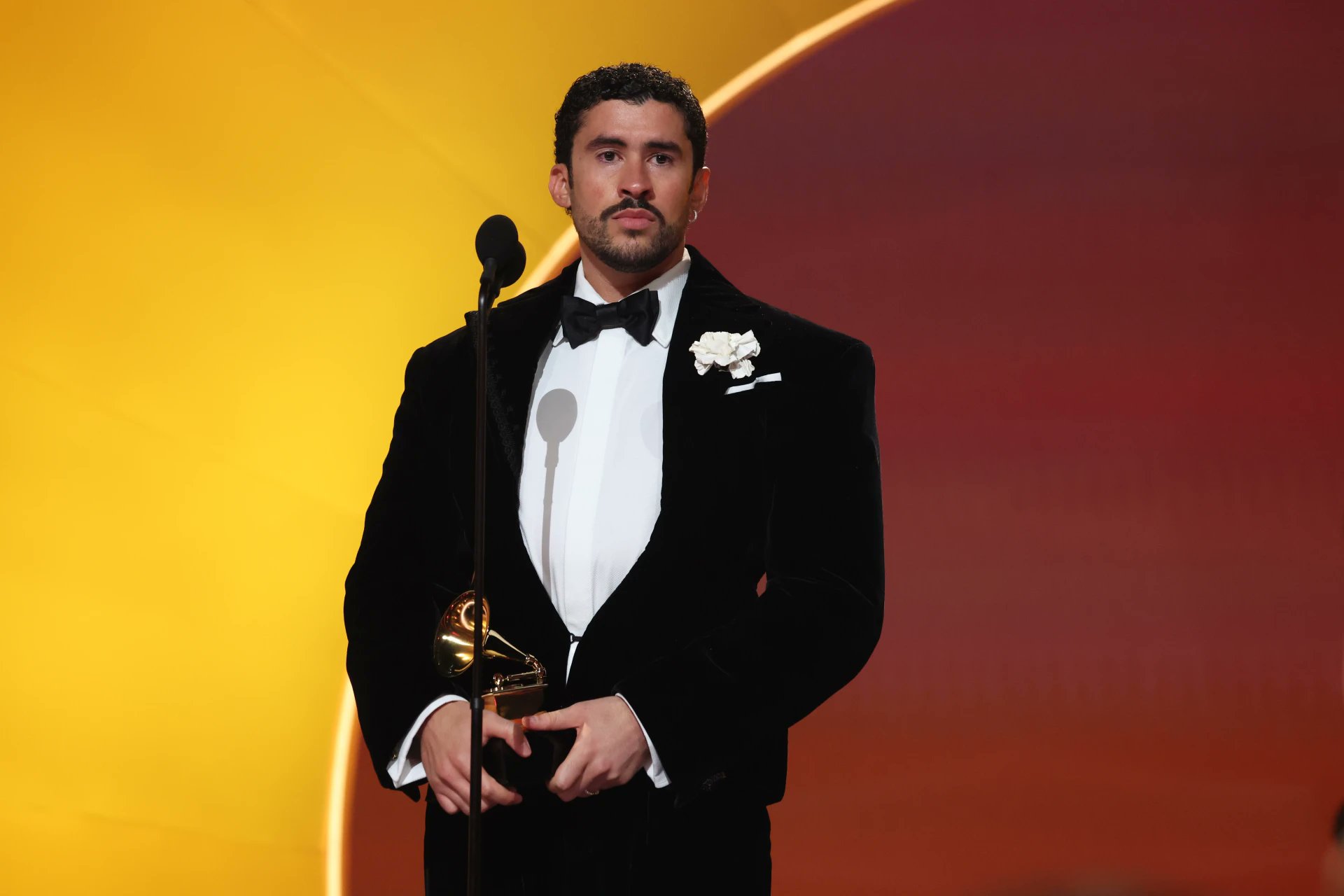
It spent over 20 weeks in the Billboard 200 Top 10 and won Album of the Year at the 2026 Grammys — the first Spanish-language album to do so — plus five Latin Grammys in 2025.
His 31-date residency No Me Quiero Ir de Aquí in Puerto Rico celebrated his homeland, drawing global fans and boosting the local economy. Activism became central: He spoke out against Puerto Rico’s government, supported LGBTQ+ rights, and critiqued anti-Latino rhetoric, dedicating awards to Latin youth.
In film, he starred in Cassandro, Happy Gilmore 2, and Darren Aronofsky’s Caught Stealing. Crowned Billboard’s Artist of the Year in 2022 and 2025, and Spotify’s most-streamed artist from 2020-2022 and 2025, his influence spans music, fashion, and culture.
Cultural Impact & the Road to the Super Bowl
Bad Bunny has revolutionized Latin music, proving Spanish-language tracks can dominate globally without compromise. His gender-fluid style — skirts, heels, and vibrant aesthetics — challenges norms, while his advocacy elevates Puerto Rican issues.
With six Grammys, 17 Latin Grammys, and billions of streams, he’s a cultural force. This Sunday’s halftime show, expected around 8-8:30 PM ET during the Seahawks-Patriots matchup, will be a 12-15 minute spectacle of his hits and heritage.
Following his 2020 guest spot with Shakira and Jennifer Lopez, this solo headline cements his legacy. From SoundCloud to the Super Bowl, Bad Bunny’s evolution is a testament to authenticity and innovation.
READ: SZA Speaks Out Against ICE After Triumphant 2026 Grammy Wins: “It’s Always F*ck ICE”